Stocks To Buy Now Blog

Stocks on Radar

SOBRsafe Inc. (NASDAQ: SOBR) Announces SOBRsure(TM) Sales Activities in Australia and New Zealand

  • SOBRsure sales activities in Australia and New Zealand have been initiated through an international channel partnership with Drug Testing Business Success
  • Drug Testing Business Success has a 14-year history representing the world’s most widely-used ankle bracelet for alcohol detection
  • The global alcohol sensor market was valued at $2.3 billion in 2022, and is expected to reach $6.3 billion by 2030
  • SOBRsafe’s products are geared toward behavioral health, justice, and consumer markets – and well-positioned for licensing and integration

SOBRsafe (NASDAQ: SOBR), a provider of next-generation transdermal alcohol detection solutions, recently announced that it has initiated SOBRsure(TM) sales activities in Australia and New Zealand through an international channel partnership with Drug Testing Business Success – the region’s leading drug and alcohol testing provider. Drug Testing Business Success has extensive experience in the transdermal alcohol detection industry, representing the world’s most widely-used ankle bracelet for 14 years (https://ibn.fm/hjnG5).

The company intends to drive SOBRsure orders through a coalition of suppliers and a dedicated e-commerce website focusing on behavioral health and justice. After the 90-day proof-of-concept, SOBRsure has been launched for sale and is in active client use.

“We believe we are gaining momentum and demonstrating traction in the behavior health and justice markets here in the US, and this most recent agreement with our newest channel partner is a meaningful validation of our technology and approach,” said SOBRsafe Chairman and CEO Dave Gandini. “We’re excited about this new revenue stream in Australia and New Zealand, and we believe that this could accelerate broader global expansion.”

According to Data Bridge Market Research, an international market research and consulting firm, the global alcohol sensor market was valued at $2.3 billion in 2022, and is anticipated to reach $6.3 billion by 2030, growing at a CAGR of 13.7%. The market is expected to grow due to the rising rates of alcohol consumption, stricter laws pertaining to alcohol consumption, and new, more effective detection technologies (https://ibn.fm/SSfwO).

SOBRsafe has a powerful backend data platform and provides humane, passive, and connected alcohol detection for the behavioral health, justice, and consumer markets. The SOBRsafe technology is integrated within the company’s robust and scalable data platform, producing statistical and measurable user and business data. The company’s products include:

  • SOBRsafe(TM) – The company’s scalable, patent-pending platform for non-invasive alcohol detection, real-time reporting, and historical data aggregation for use as a solution with broad application in the behavioral health and justice markets, and for consumer use. 
  • SOBRcheck(TM) – The company’s stationary identification and alcohol monitoring product, providing a quick, specific point-in-time test for the presence of alcohol. SOBRcheck provides administrators with immediate results, delivered securely, to aid in efficiently managing an existing substance abuse policy.
  • SOBRsure(TM) – The company’s transdermal, alcohol-detecting wearable that provides continuous, mobile alcohol monitoring. The advanced alcohol safety technology discreetly detects and instantaneously reports the presence of alcohol in the body. SOBRsure provides app-based alcohol detection alerts, pinpoint location tracking and band-removal notifications.

SOBRsafe believes its technology is a superior, hygienic alternative to traditional breathalyzers for frontline, preventative applications. Legacy detection technologies are invasive and inefficient, unhygienic, and unconnected. Alcohol detection with SOBRsafe products does not require breath, blood, or urine; it only requires contact with the skin.

For more information, visit the company’s website at www.SOBRsafe.com.

NOTE TO INVESTORS: The latest news and updates relating to SOBR are available in the company’s newsroom at https://ibn.fm/SOBR

Lexaria Bioscience Corp.’s (NASDAQ: LEXX) CEO, Chris Bunka, Shares 2023 Company Update and 2024 Roadmap in Annual Letter

  • Lexaria, a global innovator in drug delivery platforms, just announced ambitious plans for the 2024 calendar year
  • The letter confirms that the 2024 plans have been made possible by significant strides that were made by the company in 2023
  • Lexaria looks to build on the momentum gained from the previous year, ultimately asserting market dominance and making 2024 its best year yet

Lexaria Bioscience (NASDAQ: LEXX), a global innovator in drug delivery platforms, just announced its ambitious plans for the 2024 calendar year. In his annual letter, Chris Bunka, Lexaria’s CEO, noted that this would mark the year that will prove all of the company’s work of producing hard, factual scientific information worth it, accomplishments that were critical given 2023’s challenges in the capital markets (https://ibn.fm/vcLob).

Bunka lauded his team for the strides the company made in 2023. Of note was its high success rate in its research and development (“R&D”), all necessary for the coming year. The company experimented with its patented DehydraTECH(TM) technology using an entirely new class of molecules, opening more possibilities for Lexaria. Most notably, its GLP-1 study yielded positive interim and final human pilot study results, showing that the technology delivered a statistically significant proportion of semaglutide and did so more quickly.

“Frankly, the results surprised us with their level of positivity,” noted Mr. Bunka. “It was found that DehydraTECH processing: delivered a statistically-significant higher proportion of the semaglutide, and did so more quickly; reduced the quantity and severity of unwanted side effects; and had a statistically-significant impact on blood sugar in general and much more effectively after eating a meal, than did Rybelsus,” he added.

Such positive results cut across all of Lexaria’s studies, from hypertension to cholesterol, triglyceride and weight loss management, human hormones, blood glucose, and diabetes, as well as oral nicotine. Bunka noted the challenge of convincing companies active in Consumer Packaged Goods (“CPG”) sectors to pay for technology to improve their product offerings, given thin margins.

Bunka acknowledged Invenomic Capital Management LP, who have been shareholders at Lexaria for a long time and who have accumulated more stock throughout the year.

While dealing with anticipated challenges, Lexaria had many wins for 2023, among which were ten newly granted patents. This brought the total patents granted to 38 and made 2023 the year Lexaria was granted the most patents since its inception. This, in addition to the roughly $800,000 recently received from the exercise of warrants, showed the company’s commitment to growing its position as a leader in its segment. The company looks to build on this momentum for 2024, ultimately asserting market dominance and making it the best year yet.

For more information, visit the company’s website at www.LexariaBioscience.com.

NOTE TO INVESTORS: The latest news and updates relating to LEXX are available in the company’s newsroom at https://ibn.fm/LEXX

China Rare Earths ‘Crisis’ Spells BIG Opportunity

We’ve known this was coming, for a very long time.

For well over a decade, various experts have been warning governments and industry about global over-reliance on China for the supply of rare earth elements (REE). Now, this day of reckoning has arrived.

Beginning in the spring of 2023, China first “threatened” to impose restrictions on the export of some rare earths. Just recently, China passed a law that could reduce its exports of critical REE.

However, you don’t have to be Chinese to see “crisis” and “opportunity” as being two sides of the same coin. Fortunately, a number of mining companies (outside of China) have heeded previous REE warnings and focused their energies on developing rare earth assets.

One of these companies, Appia Rare Earths and Uranium Corp (CSE:API / OTCQX:APAAF), holds multiple REE and uranium projects, with three taking precedence due to their world-class mineralization. Notably, one already holds a defined resource estimate for both REE and uranium. More on this later – REE and their commercial importance.

Before discussing new investment opportunities with rare earths, many investors will need some further education.

What are rare earths? What is their principal use/importance in industry? Once those questions are answered, the significance of China’s export restrictions comes into focus.

The term “rare earth element” is a misnomer, in some respects. Rare earths are, in fact, metals. And they are not actually that rare.
The 17 REE (if scandium is included) are ~200 times more abundant than gold. However, what is rare is to find these REE in sufficient concentrations to permit commercial extraction.

Rare earths are divided roughly equally into light rare earth elements (LREE) and heavy rare earth elements (HREE) based upon their atomic mass, with gadolinium classified as either an LREE or HREE.

In terms of investment opportunities with rare earth elements, this can be summarized with one word: magnets.

Because of their impressive chemical and metallurgical properties, REE have numerous unique applications in both hi-tech and low-tech. These include:

  • Clean energy generation
  • Lasers
  • Phosphors
  • Chemical catalysts
  • Polishing compounds
  • Glass and ceramics
  • X-ray tubes
  • Data storage
  • Numerous hi-tech military applications

In many cases, there are few or no substitutes for REE in the manufacturing of these other products. However, these are generally not large markets for rare earth elements.

The reason that magnets, specifically high-performance permanent magnets, dominate the global market for rare earths can also be summarized in one word: scale.

This becomes apparent once readers become aware of how useful and important these high-performance magnets are. They are essential components of all electric motors, such as those in electric vehicles and wind turbines.

These high-performance magnets, or “super magnets” are also used in most high-end electronics – such as smartphones. In short, these high-performance magnets are used in much of our daily lives.

How A Potential Crisis Becomes An Opportunity

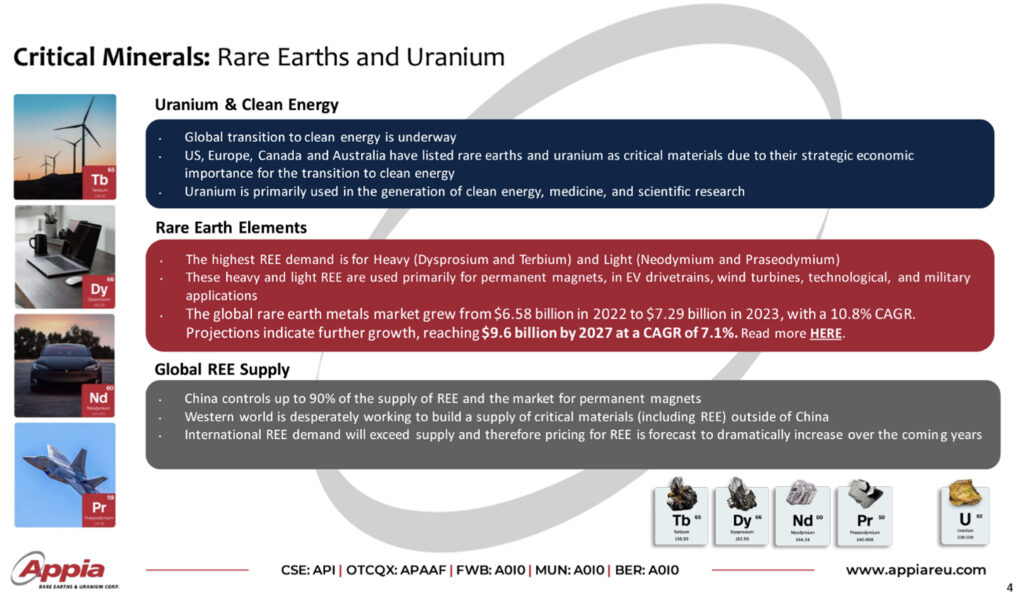
Generally speaking, it is the heavy rare earths (HREE) that are most useful in the production of these high-performance magnets, specifically dysprosium (Dy) and terbium (Tb).

However, two of the LREE are also used extensively in the production of these super magnets: neodymium and praseodymium. Neodymium (Nd) is used to make the strongest magnets, while praseodymium (Pr) can often be substituted for neodymium.

These four rare earths comprise the main magnet rare earths (MRE) that are needed to be produced at a large scale. That’s how the global rare earths market looks in terms of demand.
Then there is the supply of rare earth elements. Here is where the scarcity of REE enters into the equation.

The HREE are decidedly rarer than the LREE. For companies developing rare earth projects, this means that the HREE content in rare earths deposits is viewed as a key factor in project value.

With rare earth elements also being essential ingredients in many high-end military technologies, this explains why a rare earths (supply) “crisis” has been regarded as such a serious issue.

One person who sees the current scenario much more in terms of an opportunity than a crisis is REE industry expert, Jack Lifton. Lifton has previously been quite outspoken on this subject.

North America Doesn’t Need China’s Rare Earths

Thanks to the emergence of REE producers in the Western hemisphere and the growth in the number of advanced-stage REE development projects, Lifton saw the Rest of the World as being ready-and-able to meet its supply needs for rare earth elements.

Indeed, in a subsequent interview, Lifton didn’t even see Chinese policies aimed at reducing global dependence on its REE as being punitive in nature.

My thinking about this has evolved. I think that the Chinese want this to happen [less dependence]. The Chinese are now restructuring their REE production industry and downsizing it to match their internal demand. They will grow the industry in the future, but only to meet their domestic demand. I do not believe that the Chinese are interested in the REE export business.

And that interview was in 2013 – a full decade ago. Flash forward to 2023 and only now do we see China imposing mild restrictions on its exports of REE.

A potential “crisis” is becoming an investment opportunity. For North American-based mining companies, the global market for REE is a tempting target.

China has traditionally attached substantial export duties to its REE exports. If Lifton’s premise is correct and China wants to reduce its global market share of REE, then it is unlikely to relax its export duties as new competitors enter the marketplace.

This translates into the potential for strong margins for North American-based companies that are either already going into production of REE, or have advanced-stage projects which can be moved to production expeditiously.

Enter Appia Rare Earths and Uranium Corp.

Enormous opportunity in rare earths and uranium

When Investor Brands Network sat down for a chat with President Stephen Burega and the Appia management team, two factors immediately shone through: the quality of Appia’s rare earths and uranium assets, and the value opportunity for investors.

Appia doesn’t merely offer investors one project with enormous potential upside. The Company boasts three such projects.

Elliot Lake Uranium & REE Project

This is Appia’s most advanced project to date.

Elliot Lake is a 13,008 hectare property, with a 100% interest held by Appia. It is located in the Elliot Lake uranium camp that has already produced over 300 million pounds of U3O8.

Elliot Lake has a large, high-grade uranium resource. This is comprised of 8.0 million pounds of U3O8 in the Indicated category (Teasdale Zone), with an average grade of 0.554 lbs/ton U3O8.

The Company also has 47.7 million pounds lbs of U3O8 in the Inferred category. This is split between the 20.1 million pounds from the Teasdale Zone (average grade 0.474 lbs/ton U3O8) and 27.6 million pounds from the Banana Zone, with an average grade of 0.912lbs/ton U3O8.
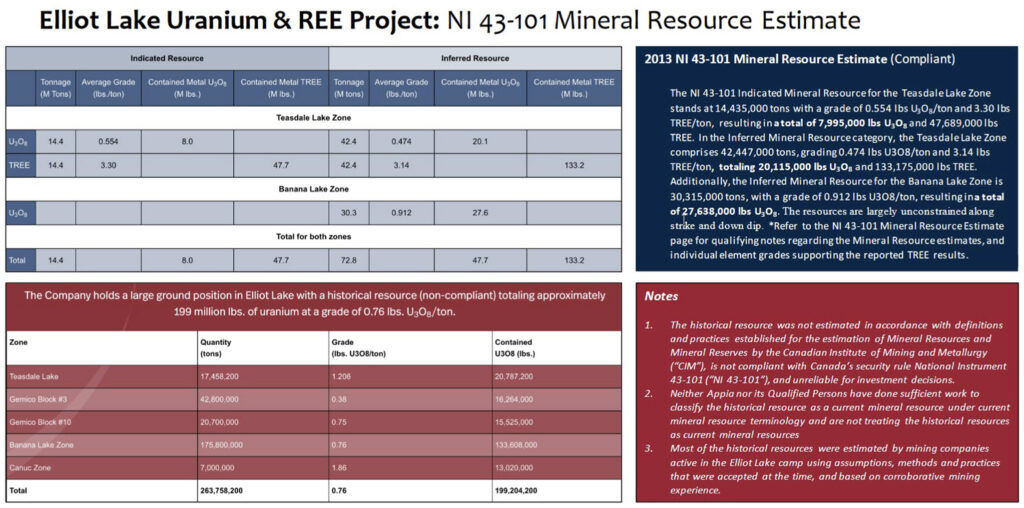
Note that a historical resource estimate for Elliot Lake (not NI 43-101 compliant) reported a contained U3O8 resource of 199.2 million pounds. This indicates a strong possibility for substantial U3O8 resource expansion at Elliot Lake.

With the uranium sector red-hot at the moment, Investor Brands Network is planning an upcoming feature article focusing on the big uranium opportunity at Elliot Lake.

However, where you find uranium mineralization you will also often find REE mineralization as well. The Elliot Lake resource estimate contains even larger rare earths resources.

The NI 43-101 rare earths resources at Elliot Lake total ~180 million pounds: an Indicated resource of 47.7 million pounds with an average grade of 3.30 lbs/ton TREE (total rare earth elements), and 133.2 million pounds of Inferred resource with an average grade of 3.14 lbs/ton TREE.

Which of the rare earths are present in the Elliot Lake resources? Just about all of them. Elliot Lake contains 15 of the 17 different rare earth elements.

Alces Lake REE Project

The Alces Lake REE Project is a 14,334 hectare project (100% interest) one of five properties held by Appia in Canada’s prolific Athabasca Basin of northern Saskatchewan.

While the Athabasca Basin is primarily known for its world-class uranium deposits, this region is also highly prospective for rare earths exploration. The REE grades in monazite at Alces Lake can only be described as “world class” as well.

Previous drilling has revealed widths of REE mineralization of up to 19 meters. High-grade intercepts include:

  • 6.99 meters of 11.70% TREO (total rare earth oxides) including 3.67 meters of 15.81% TREO
  • 8.98 meters of 9.46% TREO, including 0.87 meters of 17.1% TREO

However, it’s not only the outstanding grades at Alces Lake that will be of interest to investors.

The Company has discovered multiple zones of shallow and near-surface REE mineralization, in some cases less than 15 meters from the surface. If the Company can unlock a potential open-pit REE resource at Alces Lake, this would greatly improve the Project’s commercial upside.

Then there is the SRC state-of-the-art Monazite/REE Processing Facility that is being constructed in northern Saskatchewan, proximate to the Alces Lake Project.

The Saskatchewan Research Council (SRC) is a provincial business development agency that sees a major future for Saskatchewan not only in REE mining but also rare earths processing. The facility being constructed near Alces Lake is its first step in executing on this plan.

For the SRC, the high grades of REE in monazite at Alces Lake would make this Project ideal for proof-of-concept testing of its processing facility.

PCH Ionic Clay REE Project (Brazil)

Last, but certainly not least, among Appia’s premier REE projects is the PCH Ionic Adsorption Clay deposit. This is a 40,963.18 hectare property, located in Goiás State, Brazil. Appia has an option agreement in place to earn up to a 70% interest over a 5-year horizon.

Here, investors need to immediately focus on two important details: the geology and the jurisdiction.

“Ionic adsorption clay” deposits of REE are the most mining-friendly geology in which substantial concentrations of rare earth elements are hosted. This translates into more economical and efficient development of a rare earths project, from drilling right through to mine construction and mine operations.

Then there is Brazil.

As previously noted, Appia is pleased with the government support from the province of Saskatchewan with respect to its Alces Lake Project. But the Company is thrilled by the commitment of Brazil’s government to support the development of its own rare earths industry.

Talk is cheap. Brazil’s government has already committed 5 billion reals in advancing an REE industry.

All of these factors made the PCH Ionic Clay deposit a very exciting REE prospect for Appia Rare Earths and Uranium. Then came the Company’s latest drill results, released on November 28, 2023.

Appia Discovers An Unprecedented High-Grade Mineralization Zone: Total Weighted Average Grade of 7,578 ppm Or 0.76% Total Rare Earth Oxide Across 10 Reverse Circulation Drill Holes At Its PCH Ionic Clay Project, Brazil

“An unprecedented zone of high-grade mineralization.” Match that with the mining-friendly ionic adsorption clays of the PCH Project and what do you have? A game-changer.

This comprehensive drill campaign lays the groundwork for a maiden Mineral Resource Estimate (MRE) and an NI 43-101 report, presently in progress.

InvestorBrandNetwork will delve into these spectacular drill results and the PCH Project in much greater detail in an upcoming full-length feature. We’ll also take a closer look at Alces Lake and Elliot Lake, the Company itself, and Appia’s near-term plans for project development.

Appiareu.com

Appia corporate presentation

NOTE TO INVESTORS: The latest news and updates relating to APAAF are available in the company’s newsroom at https://ibn.fm/APAAF


Electronic Servitor Publication Network Inc. (XESP) Combines Powerful Digital Engagement Engine(TM) with Simple Pricing Model to Drive Growth of Client Companies

  • Electronic Servitor Publication Network provides the Digital Engagement Engine(TM), a sophisticated technology stack that helps businesses fully engage target audiences more efficiently, moving audiences from awareness to action, thereby driving growth
  • The Digital Engagement Engine(TM) is digitally transforming content marketing by solving deficiencies through a higher level of sophisticated automation
  • The technology offers numerous benefits, including enabling client companies to target their leads with greater accuracy, dynamically delivering provisioned content, and heightening the effectiveness of content marketing
  • XESP uses a pricing model that lowers the barrier to entry, allowing more customers to harness the benefits of its superior technology stack

Electronic Servitor Publication Network (OTCQB: XESP) is a digital engagement company that, through its digital activation and customer engagement solutions, provides B2B companies with intelligent interaction management, dynamic content provisioning, and a logic-driven workflow that creates dynamic digital experiences. Targeting multiple verticals, the company aims to accelerate client companies’ audiences from awareness to action, driving measurable growth.

“We are a company focused on growth – the growth of our customers. Everything we do is from that lens. We start with the end in mind. We don’t try to build you something and hope you get there. [Instead,] we start with what your growth goals are and work backward from there; we use our sophisticated technology [stack] in order to get you there,” explained XESP President and CEO Peter Hager in his presentation at the Emerging Growth Conference (https://ibn.fm/mBKMG).

XESP’s sophisticated technology stack, the Digital Engagement Engine(TM), is designed to achieve greater reach and lift for clients thanks to its use of a combination of automation, unique data management, and a modern workflow built on a microservices architecture. The tech stack also incorporates data analysis, enabling XESP to identify dozens of segments within client companies’ respective niches that can be targeted more precisely.

“We can use that same data to automatically provision content in ways that would be cost-prohibitive to accomplish manually. Plus, our system makes it easy to evaluate and fine-tune any part of the process at any time,” reads the company’s website (https://ibn.fm/kHGXW).

The benefits of the technology nonetheless extend beyond automated content provisioning and simplification of content marketing processes.

Firstly, XESP reports that Digital Engagement Engine(TM) has already helped dozens of companies achieve results “up to nine times the industry standard.”

Secondly, the Digital Engagement Engine(TM) enables client companies to target their leads with greater accuracy, dynamically delivering provisioned content that is tailored for specific audiences and which reaches them on their terms. It also leverages the latest technology to make content marketing exceptionally more effective.

Thirdly, the technology facilitates content management and optimization, which not only ensures the content is as relevant today as before but also aims to increase content consumption and community interaction to increase revenues. Put simply, the Digital Engagement Engine(TM) boosts client companies’ content monetization efforts.

Fourthly, the Digital Engagement Engine(TM) is an alternative solution to the challenges associated with traditional omnichannel marketing techniques including search engine optimization (“SEO”), social media marketing, content marketing, and video marketing. These techniques, though effective, have seen their value significantly reduced as more competitors rush in to implement them. This has led to a “saturation that is simply unsustainable,” according to XESP. On the other hand, the Digital Engagement Engine(TM), a digital differentiator, “goes beyond omnichannel marketing, meeting the individuals within your target market right where they are and creating meaningful engagements that stay with them until they become customers.”

Furthermore, as Hager expounded in his presentation, “Our results are produced at a lower cost – almost 50% lower than customers can do themselves – and we provide it as a managed service, which means you don’t need to bring your team for it. [Rather,] we bring our team and technology and deliver [the results] for you.”

To enjoy these benefits and results, client companies do not have to purchase the technology, pay for a given number of seats or licenses, or enter into long-term contracts with XESP. Instead, Electronic Servitor Publication Network provides the technology through a managed service using a simple pricing model that lowers the barrier to entry, allowing more customers to harness the benefits of its technology and processes.

Under this pricing model, clients engage XESP’s services through a quarterly fee that can potentially become recurrent depending on the client’s desire for continuous and consistent attainment of measurable results. In addition, XESP earns a growth bonus if the client achieves their desired growth and results.

With a keen focus on serving the next generation of technology-enabled businesses, XESP is leveraging its Digital Engagement Engine(TM) to help companies boost their content marketing efforts. “We focus on your results, and you focus on serving the needs of your community and customers,” XESP says of its managed service and sophisticated technology stack.

For more information, visit the company’s website at www.XESPN.com

NOTE TO INVESTORS: The latest news and updates relating to XESP are available in the company’s newsroom at https://ibn.fm/XESP

Fathom Nickel Inc. (CSE: FNI) (FSE: 6Q5) (OTCQB: FNICF) Is ‘One to Watch’

  • In December 2023, Fathom Nickel launched a non-brokered private placement to accredited investors for proceeds of C$4.5 million
  • In September 2023, Fathom drilled seven drillholes at the Gochager Lake project as a follow-up program to two drillholes drilled in February 2023; as of the end of 2023, Fathom drilled nine holes at the project amounting to ~2,800 meters
  • Fathom Nickel in June 2023 announced completion of a non-brokered private placement to accredited investors for proceeds of C$3 million
  • The company in June 2023 commenced geophysical survey programs at its Albert Lake and Gochager Lake nickel projects
  • Fathom Nickel in September 2022 entered an option agreement to acquire 100% of the Gochager Lake nickel project
  • The company went public in May 2021, listing on the Toronto-based Canadian Securities Exchange and later on the OTCQB Venture Exchange

Fathom Nickel (CSE: FNI) (FSE: 6Q5) (OTCQB: FNICF) is a Canadian natural resource development and exploration company that targets high-grade nickel sulfide discoveries for use in the rapidly growing global electric vehicle (“EV”) market. The company has a portfolio of two high-quality exploration projects located in the prolific Trans Hudson Corridor in Saskatchewan.

Led by a management team with more than 100 years of combined mining and exploration experience, Fathom believes in a continuing bright outlook for nickel and its increasing use in the manufacturing of batteries needed for energy storage in the high-growth renewable energy and EV industries. The company’s modern approach to exploration has yielded significant new nickel discoveries.

Fathom is headquartered in Calgary, Alberta.

Projects

The Albert Lake Project

The Albert Lake Project comprises 90,460 hectares of lands located in north-central Saskatchewan, with over 80,000 hectares currently unexplored. The project is host to the historic Rottenstone Mine, a high-grade, open pit nickel sulfide past producer that was active from 1965 to 1969 and yielded ~26,000 tonnes of 3.3% Ni, 1.8% Cu, and >9 g/t Pd-Pt+Au.

The geological setting of the Albert Lake Project is within the Trans Hudson Orogeny (Corridor), which is host to numerous world-class nickel mining camps including the Thompson Nickel Belt (currently operating with more than 5 billion pounds of nickel produced since 1959), Lynn Lake (past producer) and Raglan Nickel Belt (currently operating with more than 39,000 tons of nickel produced in 2020).

The project is fully permitted. Exploration plans for 2024 include drilling a high-priority target located approximately 2km south of the historic Rottenstone Mine along with drilling other high-priority targets. Additional soil geochemistry, surface geophysical programs and geological mapping and prospecting will be performed during the summer field season.

The Gochager Lake Project

The Gochager Lake Project in northern Saskatchewan, also in the prolific Trans Hudson Corridor, was recently expanded through the addition of the contiguous Watt’s Lake property and direct staking, bringing its total land area to 22,620 hectares.

The Gochager Lake property is host to a historic resource defined by drilling in 1966-1967 consisting of 4.2 M tons grading 0.29% Ni and 0.08% Cu. Recent drilling by Fathom has defined multiple very robust off-hole borehole electromagnetic (“BHEM”) responses in eight of nine holes drilled in 2023 and three historic drill holes probed. There is very strong evidence of multiple, high-grade nickel-copper-cobalt steeply oriented chutes within the historic Gochager Lake Deposit.

Prior to Fathom exploration in 2023 and since 1970, exploration at the property has been limited to small drill programs in 1989-1990 and 2018. Exploration plans for 2024 include expanded surface geophysical programs, drilling and continued BHEM surveys to expand tons and increase the grade of the historic Gochager Lake deposit. Summer exploration will consist of soil geochemistry, mapping, prospecting and additional surface geophysical programs focused on identifying other Gochager-like deposits within the current land package.

Market Opportunity

Nickel plays a crucial role in clean energy technologies, and that is expected to cause demand to well outstrip supply for the foreseeable future.

With an annual market value of around $35 billion, nickel demand is projected to rise due to its intensive use in lithium-ion batteries used to power EVs. However, new discoveries of nickel sulfide deposits (currently the most reliable source for battery-grade class 1 nickel) have been rare, which could constrain class 1 nickel supply in the coming years.

According to Deloitte’s global EV forecast, total EV sales will grow from 2.5 million in 2020 to 11.2 million in 2025, reaching 31.1 million by 2030 and representing approximately 32% of the total market share for new car sales. Over the next 10 years, the EV market is projected to see a CAGR of 29%, with increased demand for nickel expected to be comparable.

Management Team

Fathom Nickel has assembled a best-in-class leadership team consisting of highly qualified industry professionals with deep knowledge and understanding of the mineral exploration industry and capital markets.

Ian Fraser, P.Geo., is CEO, VP Exploration and Co-Founder of Fathom Nickel. He has more than 35 years of experience in mineral exploration, as well as managing and implementing exploration projects in Canada and internationally. His experience includes resource interpretation and development of the Casa Berardi Gold Mine and Komis Gold Mine, as well as the Cisneros Gold Mine in Colombia.

Doug Porter, CPA, CA, CBV, is President, CFO and Director of Fathom Nickel. He is a senior financial and accounting executive with specific emphasis in resource company management. His career includes positions with Elan Coal Ltd., Altitude Resources Ltd. and StimWrx Oilfield Services Ltd.

For more information, visit the company’s website at www.FathomNickel.com.

NOTE TO INVESTORS: The latest news and updates relating to FNICF are available in the company’s newsroom at https://ibn.fm/FNICF

Correlate Energy Corp. (CIPI) Riding the Energy Transition Wave as More Companies in the U.S. Move to Electrification

  • Correlate Energy, a publicly traded distributed energy solutions company, is looking to position itself as the go-to company as America continues transitioning to renewables and electrification
  • With the USPS announcing a $40 billion investment strategy to upgrade and improve its operations, including a major addition of EVs and charging stations, other players are following suit
  • Through its three-pronged strategy – sell, retain, and acquire – Correlate anticipates a spike in demand for its products and services that offer companies a strong economic motivation to enhance energy efficiency

Correlate Energy (OTCQB: CIPI), a publicly traded company is capitalizing on America’s growing trend toward renewables and increased energy efficiency. As such, it is positioning itself as the one-stop go-to company, for companies seeking more significant participation in renewables, cost savings, and an overall reduction in their carbon footprint. Most recently, corporations such as Continental Envelope and American Tire Distributors (“ATD”) have signed on for Correlate’s energy offerings (https://ibn.fm/6Zkhb).

Correlate anticipates continued growth in demand for its products and services, encouraged by recent announcements of major investments in operational and energy efficiency and electrification. This includes the United States Postal Service (“USPS”) announcement of a $40 billion investment strategy to upgrade and improve its processing, transportation, and delivery networks to reduce costs, slash its carbon footprint, and minimize waste. To this effect, it unveiled its first set of electric vehicle (“EV”) charging stations at its South Atlanta Sorting and Delivery Center (“S&DC”), with additional charging stations set to be installed at hundreds of new S&DCs across the country (https://ibn.fm/lKynl).

“The improvements we need to achieve in sustainability are an integral outgrowth of the broader modernization efforts we have undertaken through our 10-year Delivering for America plan,” noted Postmaster General Louis DeJoy. “As we transform our operating processes and invest in automation, new technologies, and upgraded facilities and vehicles, we will generate significant efficiencies that reduce our costs, slash our carbon footprint, and minimize waste,” he added.

USPS isn’t the only company in the U.S. that has resorted to renewable energy sources and the electrification of their fleets. FedEx, UPS, and DHL have also begun the shift, mainly influenced by mandates for federal fleets to transition to electric vehicles by 2035 (https://ibn.fm/sN0Ec).

The company continues to finance, develop, and sell localized green energy solutions and microgrids to industrial, commercial, and residential customers, and plans to retain ownership of some of these energy systems, guaranteeing its ongoing, reliable cash flow. It has also aggressively pushed to acquire proven renewable energy companies, expanding its influence in the market.

For more information, visit the company’s website at www.Correlate.Energy, including the following:

NOTE TO INVESTORS: The latest news and updates relating to CIPI are available in the company’s newsroom at https://ibn.fm/CIPI

Longeveron Inc.’s (NASDAQ: LGVN) Long-Term Follow-Up Data from Its ELPIS I Clinical Trial Presented at the 2023 Annual Scientific Sessions of the American Heart Association

  • A poster about Longeveron’s long-term follow-up data from its ELPIS I clinical trial was presented at the 2023 Scientific Sessions of the American Heart Association in November 2023
  • The poster showed that 100% of the 10 patients enrolled in the study survived and remained heart transplant-free for up to 5 years of age after receiving Lomecel-B(TM) during their Stage II surgery
  • The data supports Longeveron’s ongoing ELPIS II study, which has exceeded its 50% enrollment threshold
  • The company believes the long-term follow-up data underscore the potential for Lomecel-B(TM) as a much-needed therapeutic innovation for HLHS patients
  • Historical results from outside studies have shown that children with HLHS who are undergoing Stage II surgery have approximately 20% mortality by 5 years of age

Longeveron (NASDAQ: LGVN), a clinical-stage biotechnology company developing cellular therapies for aging-related and life-threatening conditions including hypoplastic left heart syndrome (“HLHS”), Alzheimer’s disease and Aging-related Frailty has evaluated – and still is evaluating – its lead investigational therapeutic candidate Lomecel-B(TM), an allogeneic, bone marrow-derived medicinal signaling cell (“MSC”) therapy product, in multiple clinical trials.

One of these trials, titled ELPIS I, was a Phase 1, open-label single-arm study whose final results Longeveron announced in September 2021 (https://ibn.fm/iL6z8). ELPIS I was designed to assess the safety and potential efficacy as of intramyocardial injection of Lomecel-B(TM) administered to 10 infants with HLHS during Stage II surgeries at approximately 4 months of age. The study met the primary safety endpoint: no major adverse cardiac events or any treatment-related infections during the first month post-treatment were reported. Moreover, secondary endpoints measured per protocol suggested Lomecel-B(TM) injection may improve patient long-term clinical outcome post-surgery.

While the positive results permitted the transition to a Phase 2 randomized, double-blind, controlled trial, ELPIS II, with enrollment commencing in July 2021 (https://ibn.fm/HuGcD), investigators elected to extend follow-up of the 10 infants after ELPIS I came to its planned end for a total period of five years. More than two years later, at the annual Scientific Sessions of the American Heart Association (“AHA”) held November 11-13, 2023, in Philadelphia, Pennsylvania, a poster about Longeveron’s extended long-term follow-up data was presented. (Additional long-term follow-up is still ongoing in the ELPIS I children.)

The poster, titled Long-term Transplant-free Survival Is Improved in Hypoplastic Left Heart Syndrome with Cell-based Therapy and authored by Sunjay Kaushal, M.D., Ph.D., the principal investigator of the ELPIS I study, and colleagues, showed that all the 10 children survived and remained heart transplant-free for up to 5 years of age after receiving Lomecel-B(TM) during their Stage II surgery.

The transplant-free survival follow-up on all patients enrolled in the study is ongoing.  Moreover, the average age at the time of the last follow-up visit was 4.5 years, with 2 patients being 5 years of follow-up, according to the company.

“Long-term follow-up data from our ELPIS I trial demonstrate the continued survival of the participants, and reinforce potential survival benefit of Lomecel-B(TM) for patients with HLHS,” commented Joshua M. Hare, Longeveron’s Co-Founder, Chief Science Officer, and Chair of the Board of Directors. “These data represent an additional up to 2 years of follow-up data, which point to the potential of Lomecel-B(TM) in this indication and provide support for our ongoing ELPIS II study, which has exceeded its 50% enrollment threshold. We anticipate completing enrollment in this trial in 2024.”

FDA granted Rare Pediatric Disease Designation (“RPD”), Orphan Drug Designation, and Fast Track designation to Longeveron’s Lomecel-B(TM) for treatment of HLHS. 

HLHS refers to cardiac malformations characterized by underdevelopment or absence of the left ventricle. Before the 1980s, HLHS was associated with 95% mortality within the first month of life. But in the last two decades of the 20th century, there was remarkable progress in the management of children born with HLHS, thanks to the introduction and successful implementation of operative reconstructive procedures, according to a 2000 study (https://ibn.fm/xo0Cy).

These procedures, which are still used to date, are performed in three stages. The final result is a reconstructed heart in which the right ventricle – which ordinarily pumps deoxygenated (venous) blood to the lungs – is now responsible for pumping oxygenated blood to the body through a reconstructed aorta, with venous blood returning directly to the lungs without going through the heart chambers.

While the operative procedures have helped lower mortality, some patients who have undergone surgeries still succumb to HLHS. According to a 2015 study (https://ibn.fm/r54vE), “The highest mortality for infants with HLHS undergoing surgical intervention is with Stage 1 palliation and the interstage period between Stage I and Stage II surgery, both done in the first year of life.”

Furthermore, Kaushal explained, “Historical data collected by the National Heart, Lung, and Blood Institute (‘NHLBI’) has shown that more than 15% of HLHS patients either required a heart transplant or died from their illness 12 months after having undergone Stage 2 surgery. Additional historical data from the NHLBI-sponsored Single Ventricle Reconstruction (‘SVR’) trial – the largest HLHS trial to date, with enrollment of more than 500 patients – shows that patients undergoing Stage II surgery have approximately 15% mortality by year 3 after surgery, which increased to approximately 20% mortality by 5 years.”

These statistics underscore the high unmet need among children with HLHS. Fortunately, the extended follow-up data, which show the 100% survival rate of ELPIS I patients up to 5 years post-treatment, highlight the opportunity for Lomecel-B(TM) as a much-needed therapeutic innovation for this patient group.

Investor Contact
Mike Moyer
LifeSci Advisors
Tel: 617-308-4306
Email: mmoyer@lifesciadvisors.com

For more information, visit the company’s website at www.Longeveron.com.

NOTE TO INVESTORS: The latest news and updates relating to LGVN are available in the company’s newsroom at http://ibn.fm/LGVN

Forward-Looking Statements

Certain statements in this document that are not historical facts are forward-looking statements made pursuant to the safe harbor provisions of the Private Securities Litigation Reform Act of 1995, which reflect management’s current expectations, assumptions, and estimates of future operations, performance and economic conditions, and involve risks and uncertainties that could cause actual results to differ materially from those anticipated by the statements made herein. Forward-looking statements are generally identifiable by the use of forward-looking terminology such as “believe,” “expects,” “may,” “looks to,” “will,” “should,” “plan,” “intend,” “on condition,” “target,” “see,” “potential,” “estimates,” “preliminary,” or “anticipates” or the negative thereof or comparable terminology, or by discussion of strategy or goals or other future events, circumstances, or effects. Factors that could cause actual results to differ materially from those expressed or implied in any forward-looking statements in this release include, but are not limited to, the ability of Longeveron’s clinical trials to demonstrate safety and efficacy of the company’s product candidates, and other positive results; the timing and focus of the company’s ongoing and future preclinical studies and clinical trials and the reporting of data from those studies and trials; the size of the market opportunity for the company’s product candidates, including its estimates of the number of patients who suffer from the diseases being targeted; the success of competing therapies that are or may become available; the beneficial characteristics, safety, efficacy and therapeutic effects of the company’s product candidates; the company’s ability to obtain and maintain regulatory approval of its product candidates in the U.S., Japan and other jurisdictions; the company’s plans relating to the further development of its product candidates, including additional disease states or indications it may pursue; the company’s plans and ability to obtain or protect intellectual property rights, including extensions of existing patent terms where available and its ability to avoid infringing the intellectual property rights of others; the need to hire additional personnel and the company’s ability to attract and retain such personnel; the company’s estimates regarding expenses, future revenue, capital requirements and needs for additional financing; the company’s need to raise additional capital, and the difficulties it may face in obtaining access to capital, and the dilutive impact it may have on its investors; the company’s financial performance and ability to continue as a going concern, and the period over which it estimates its existing cash and cash equivalents will be sufficient to fund its future operating expenses and capital expenditure requirements. Additionally, Longeveron makes no assurance that any public offering of its securities as described herein will occur at all, or that any such transaction will occur on the timelines, in the manner, or on the terms anticipated due to numerous factors. Further information relating to factors that may impact the company’s results and forward-looking statements are disclosed in the company’s filings with the Securities and Exchange Commission, including Longeveron’s Annual Report on Form 10-K for the year ended December 31, 2022, filed with the Securities and Exchange Commission on March 14, 2023 and its Quarterly Reports on Form 10-Q filed with the SEC. The forward-looking statements contained in this presentation are made as of the date of this presentation, and the Company disclaims any intention or obligation, other than imposed by law, to update or revise any forward-looking statements, whether as a result of new information, future events, or otherwise.

Turbo Energy’s (NASDAQ: TURB) Sunbox Selected to Power Up Solar360’s Capabilities Aiming to Transform Spain’s Photovoltaic Landscape in 2024

  • Turbo Energy announces strategic partnership with Solar360, a joint venture between two Spanish heavyweights, Repsol and Telefónica España
  • Turbo Energy will be the technology provider while Solar360 will be tasked with marketing energy services and installing Turbo Energy’s smart batteries in residential, commercial, and industrial locations in Spain
  • The companies are optimistic that this partnership will revolutionize the photovoltaic market in 2024, delivering substantial value to both parties and to consumers

Turbo Energy (NASDAQ: TURB), a photovoltaic energy storage innovator, has started the new year on a high note with a strategic alliance announcement. The company has forged a collaboration with Solar360, a joint venture of Repsol and Telefónica España, signaling a promising beginning for Turbo Energy in 2024. In this partnership, Turbo Energy will supply technology while Solar360 will take on the responsibility of promoting energy services by installing Turbo Energy’s smart batteries in residential, commercial, and industrial locations across Spain (https://ibn.fm/SFkkc).

The two companies join forces in a bid to optimize user savings and ensure energy availability beyond sunny periods. Aligning with their shared objective, this collaboration appears well-matched in the rapidly expanding solar photovoltaic self-consumption sector. Turbo Energy aspires to revolutionize solar energy consumption through innovative AI-driven solutions, enabling consumers to optimize solar potential and cut electricity costs for a more sustainable and energy-efficient future. Solar360 combines Telefónica’s technological and IoT expertise with Repsol’s experience in self-consumption to offer tailored electricity rates and comprehensive solar panel installations for individual customers, communities, and businesses.

Sunbox, Turbo Energy’s flagship product, is the first to be launched by Solar360. As an all-in-one energy solution integrating an inverter, battery, and AI-powered software, Sunbox seeks to manage and store photovoltaic energy efficiently through a user-friendly mobile application. “We are delighted that a market leader like Solar360 has chosen our Sunbox device as a distinctive and innovative product for their value proposition. We are excited about this partnership and believe it will bring value to both sides as well as to a broad variety of consumers,” said Mariano Soria, CEO of Turbo Energy while announcing the partnership.

Sunbox promises to deliver substantial cost savings through an intelligent energy storage system leveraging AI for real-time analysis of diverse data reflecting consumption habits, photovoltaic generation, weather conditions, and applied electricity rates. Solar panels marketed by Solar360 come equipped with an AI-powered battery system, allowing users to manage the energy generated effectively. Users can strategically utilize this stored energy during peak grid demand periods, optimizing cost savings. Additionally, the system enables users to decide the amount of battery reserve for emergencies (https://ibn.fm/1ErEn). Solar360 also commits to providing a photovoltaic production guarantee, which ensures that if the installed system generates less energy than initially estimated in the offer, the company will compensate for the shortfall during the initial year or throughout the amortization period if the customer opts for maintenance.

Turbo Energy monitors users’ energy installations in real-time, tracking both production and consumption. This functionality empowers users to utilize solar-generated energy efficiently during peak consumption hours. In anticipation of adverse weather conditions, the Turbo Energy app ensures that the batteries are fully charged, providing users with a reliable energy source during such events.

Guillermo Barth, CEO of Solar360, does not hide ambitious plans with this partnership. “With this launch, we are revolutionizing the photovoltaic sector with an innovative and distinctive offering in the market, focused on maximizing our customers’ savings. Our goal is to revolutionize the photovoltaic market in 2024,” he concluded.

For more information, visit the company’s website at www.Turbo-e.com.

NOTE TO INVESTORS: The latest news and updates relating to TURB are available in the company’s newsroom at https://ibn.fm/TURB

Clene Inc. (NASDAQ: CLNN) Reports ‘Unprecedented,’ Statistically Significant Long-Term Clinical Improvements for VISIONARY-MS Trial Participants with Stable Relapsing-Remitting MS

  • Clene recently reported new results from the open-label, long-term extension (“LTE”) of the VISIONARY-MS trial, involving participants with stable relapsing Multiple Sclerosis (“MS”) through week 144 (over 2.75 years) after the initial randomization
  • Results from the 48-week double-blind period showed statistically significant improvements in vision (primary endpoint), as well as a combined improvement in cognition, walking speed, upper extremity function, and vision (secondary endpoint) with CNM-Au8 treatment, with further significant improvements in both vision and cognition extending throughout the 96-week LTE
  • One of the trial’s key clinical advisors hailed the results as robust and consistent, describing the observed long-term clinical improvements as unprecedented
  • Data from both the double-blind trial period and the LTE build a strong case for pursuing CNM-Au8(R) in upcoming Phase 3 studies, said Dr. Benjamin Greenberg, Head of Medicine at Clene

Clene (NASDAQ: CLNN) and its wholly owned subsidiary Clene Nanomedicine Inc., a clinical-stage biopharmaceutical company focused on improving mitochondrial health and protecting neuronal function to treat neurodegenerative diseases, recently reported new results from the open-label long-term extension (“LTE”) of the VISIONARY-MS trial (https://ibn.fm/5QSDO). This was a double-blind, placebo-controlled Phase 2 clinical trial comprised of participants with chronic optic neuropathy associated with stable relapsing Multiple Sclerosis (“RMS”).

About Multiple Sclerosis

RMS is a disease of the central nervous system in which the body’s own immune system attacks myelin in the brain (the protective sheath that covers and protects nerve fibers). These attacks disrupt communication between the brain and the rest of the body (https://ibn.fm/2oZZU). About 80-90% of people with MS are diagnosed with RMS. A person with this type of MS experiences episodes of new or worsening symptoms, known as relapses, that often occur without warning. The symptoms of RMS include difficulties with vision, trouble with balance, numbness particularly in the feet, weakness, fatigue, difficulty thinking clearly, lack of coordination, need to urinate urgently and frequently, and depression (https://ibn.fm/YPMI8). Several FDA-approved disease-modifying treatments (“DMTs”) for relapsing MS are now available and have been shown to effectively suppress relapses. Despite these drugs, continued disease progression in MS occurs, and no drug currently on the market has been shown to recover function once function has been lost.

Optic neuritis is often associated with MS. Optic neuritis in MS occurs when the optic nerve is damaged by inflammation. The optic nerve carries messages from the eye to the brain and enables our brain to process and interpret what we see. Visual impairments associated with MS can be measured using a special eye chart in which grayed-out letters appear on a white background. The number of letters a person can accurately identify on the eye chart is a measure of low contract letter acuity.

VISIONARY-MS Trial

In order to help MS patients, Clene initiated the VISIONARY-MS trial to investigate the protection or improvement of neurological function following the administration of the company’s CNM-Au8(R) as a potentially remyelinating and neuro-reparative treatment. 92% of all participants in the trial continued the use of highly effective immunomodulatory disease-modifying therapies as background standard of care. As part of the study, participants drank a dose of CNM-Au8 (15 or 30 mg) or placebo daily over 48 weeks.

The trial’s primary outcome was low contrast visual acuity (“LCLA”), an assessment of visual function, or how well people living with optical neuritis caused by their MS can see. Global neurological improvement, measured by modified Multiple Sclerosis Functional Composite (“mMSFC”), which is comprised of assessments for vision, cognition (working memory and processing speed), fine motor dexterity, and walking speed, was the secondary outcome.

Long-Term Open-Label Extension

After completion of the 48-week treatment period, study participants were offered the opportunity to continue receiving CNM-Au8 30 mg for up to nearly two additional years in the LTE. Most placebo participants chose to participate and transitioned to CNM-Au8 for the LTE. Clene announced topline results from the double-blind period of VISIONARY-MS in Q3 2022, and then a few weeks ago announced results from the LTE, which covered assessments conducted through the total of week 144 (35 months after the initial randomization). The company reported analyses for the modified intent to treat (“mITT”) population that included all study participants with valid clinical data.

The results from the LTE included:

  • Statistically significant (p < 0.0001) progressive vision improvement as measured by LCLA through week 144 as compared to the original randomization baseline
  • Statistically significant (p < 0.0001) progressive cognitive improvement as measured by the Symbol Digit Modality Test (“SDMT”) through week 144 as compared to the original randomization baseline

According to these trial data, placebo patients who transitioned to CNM-Au8 during the LTE showed significant improvements (compared to the original baseline in LCLA and SDMT) after switching to active drug that were consistent with the increases observed in participants originally randomized to CNM-Au8. Moreover, Clene reported that the improvements demonstrated during the initial 48-week treatment period were maintained in the LTE for the timed 25-foot walk test (“T25FWT”), a part of the mMSFC that assessed walking speed, and the nine-hole peg test (“9HPT”), a part of the mMSFC which is used for assessing upper extremity function.

“These observed long-term clinical improvements for participants with stable disease, over and above background immunomodulatory disease-modifying therapy, are unprecedented,” shared Professor Michael Barnett, one of the trial’s key clinical advisors. “The data show clear overall improvements in vision and cognition for participants treated for nearly three years from randomization. Importantly, these results were robust and consistent. Positive impacts on disease progression and the potential to at least partially reverse established disability, if confirmed in a larger study, represent a major therapeutic leap for patients with MS.”

According to Benjamin Greenberg, M.D., Head of Medicine at Clene, the data from the 48-week double-blind period and the 96-week LTE continue to strongly support efforts to pursue CNM-Au8 in upcoming Phase 3 studies. “Clinically significant improvement is rarely seen in MS patients and this trial provides evidence of CNM-Au8’s potential to improve function in this population. Clene is currently reviewing these data with prospective pharmaceutical partners interested in MS,” added Greenberg.

Clene expects to present the full clinical results for the LTE at the ninth annual Americas Committee for Treatment and Research in Multiple Sclerosis (“ACTRIMS”) Forum scheduled for February 29 – March 2, 2024, in West Palm Beach, Florida.

The gold nanocrystal suspension, CNM-Au8, is an investigational first-in-class therapy with neuroprotective and neuroreparative properties attributed to the nanocrystals’ ability to catalytically improve energetic metabolism in central nervous system cells. Clene is currently developing CNM-Au8 as a disease-modifying treatment for people living with Amyotrophic Lateral Sclerosis (“ALS”), Parkinson’s Disease, and MS.

For more information, visit the company’s website at www.Clene.com.

NOTE TO INVESTORS: The latest news and updates relating to CLNN are available in the company’s newsroom at https://ibn.fm/CLNN

Astiva Health Differentiating Itself in Medicare Market, Working to Provide ‘Robust, Stable’ Offerings

  • CMS forecasts enrollment in Medicare Advantage programs will increase from 31.6 million in 2023 to 33.8 million in 2024
  • Astiva Health recently expanded into three Southern California counties, resulting in the company reaching the 10,000-member milestone mark
  • Astiva is committed to reshape healthcare delivery, increased access to quality healthcare

In a space where a growing number of individuals are qualifying for Medicare, Astiva Health is differentiating itself as a fast-growing Medicare Advantage Prescription Drug (“MAPD”) health plan focused on redefining the standards of personalized and comprehensive healthcare. As an indication of its success in, Astiva company recently reached a key milestone, surpassing the 10,000-member mark (https://ibn.fm/bQ6jM).

“Enrollment in Medicare Advantage is projected to increase from 31.6 million in 2023 to 33.8 million in 2024,” stated a release from the Centers for Medicare and Medicaid Services (“CMS”) (https://ibn.fm/b5H40). “The projected Medicare Advantage enrollment in 2024 will represent approximately 50% of all people enrolled in Medicare, compared to approximately 48% for 2023.”

The press release went on to quote CMS deputy administrator and director of the Center for Medicare Meena Seshamani, MD, PhD, who said: “Today’s release shows that, as expected, people with Medicare will continue to have robust options and stable benefit offerings in the MA market.”

Astiva is one of the companies committed to providing those robust and stable offerings to a growing number of people looking for the best Medicare options. Reaching the 10,000-member milestone — a substantial increase from Astiva’s 4,700 members in September 2023 — came in part from the company’s recent strategic expansion into the California counties of Los Angeles, Riverside, and San Bernardino. According to the company, the expansion, which went into effect on Jan. 1, 2024, marks a pivotal moment in Astiva Health’s mission to reshape healthcare delivery and increased access to quality healthcare for a diverse range of individuals in Southern California.

“Astiva Health’s rapid growth to over 10,000 members reflects our commitment to providing personalized and culturally responsive healthcare,” said Astiva Health cofounder and CEO Dr. Tri T. Nguyen. “Our expansion into these three counties has not only allowed us to serve a wider community but also to deepen our impact in meeting the unique healthcare needs of our members.”

Astiva is working to achieve its goal of redefining the standards of personalized and comprehensive healthcare by focusing on improving member services, comprehensive medical care, prescription drugs, and great supplemental benefits. In addition, the company’s commitment to offer multilingual solutions and educational resources means that its members experience care that is both effective and culturally sensitive.

“This membership increase is a testament to Astiva Health’s robust and member-centric approach, which prioritizes building lasting relationships and addressing the unique needs of its members,” the company states. “It also signifies the trust and confidence that the community places in Astiva Health as their healthcare provider.”

Astiva Health is a fast-growing MAPD health plan committed to redefining the standards of personalized and comprehensive healthcare. With a mission to elevate the well-being of individuals, Astiva Health specializes in innovative health plans tailored to meet the unique requirements of its members.

The organization prioritizes a culturally responsive approach to healthcare and is dedicated to serving the underserved population, not only fulfilling a critical societal need but also positioning the company to tap into a market segment with significant growth potential. By addressing the diverse healthcare needs of its members, Astiva Health aims to create lasting relationships and contribute to the overall well-being of the communities it serves.

For more information, visit the company’s website at www.AstivaHealth.com.

NOTE TO INVESTORS: The latest news and updates relating to Astiva Health are available in the company’s newsroom at https://ibn.fm/Astiva

From Our Blog

Frontieras North America Inc. Unlocks Value in America’s Energy Future

April 10, 2026

Frontieras North America is emerging as a noteworthy innovator and attractive potential investment opportunity by addressing one of the most critical challenges facing modern technology: the rapidly growing demand for reliable, affordable electricity.  As artificial intelligence (“AI”) and data-intensive computing expand, global electricity demand is projected to soar, with some analysts estimating AI-related power needs […]

Rotate your device 90° to view site.